Eyes Unclouded - Season 1 Debrief
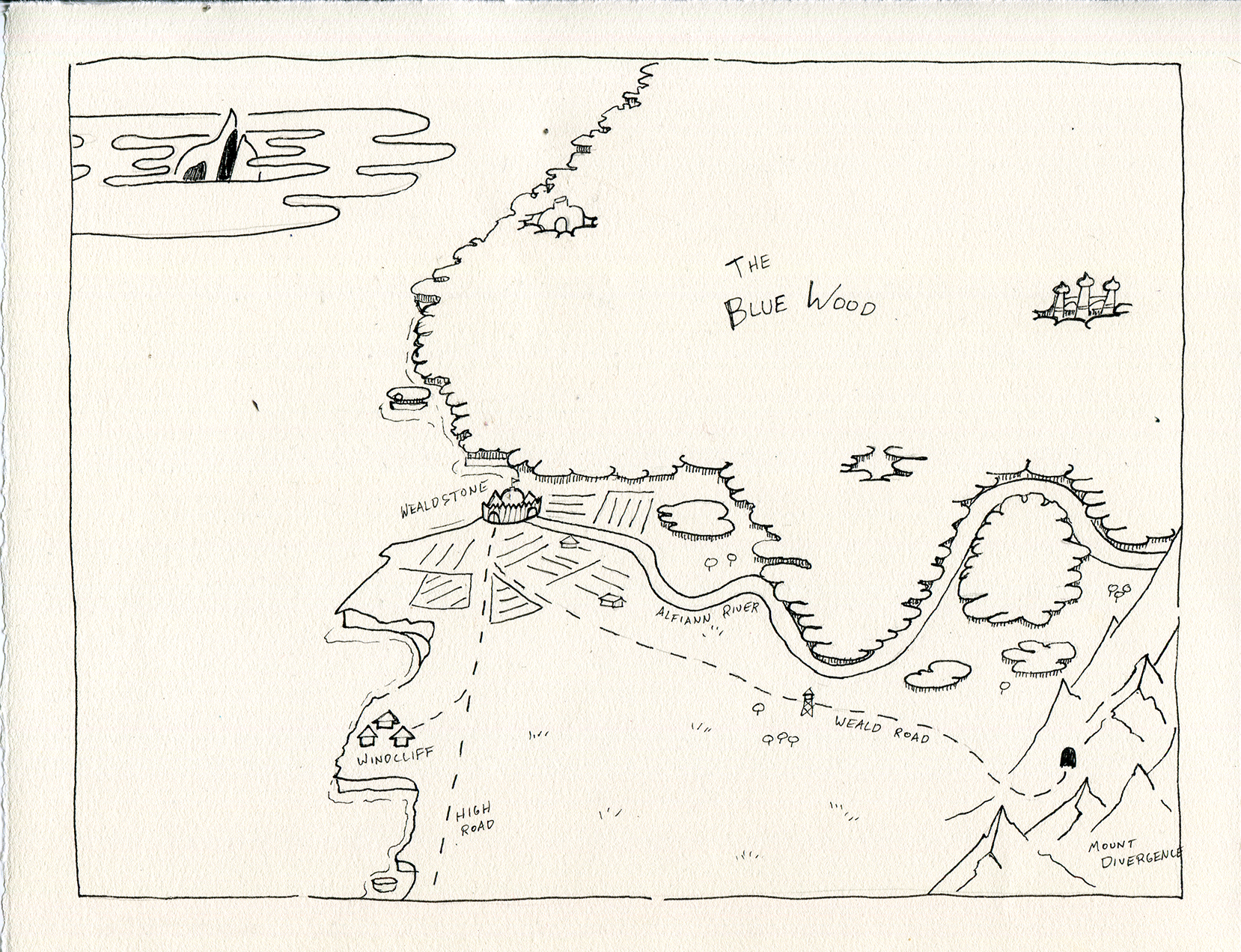
Just a couple weeks ago, my in-person group completed what we're calling a "season" of Eyes Unclouded, a Studio Ghibli-inspired game of heavily modified Cairn 2e. If you're a sicko like me, you can read 38 posts' worth of session reports to see how it went.
To provide a brief summary, the party responded to a letter exhorting them to come to the Blue Woods and investigate a supernatural threat causing the forest to expand at an alarming rate. Along the way they freed an enslaved fire elemental from a court of wizards, earned the favor of a Cat King, and investigated an ancient love triangle between a wolf, an elk, and an herbalist at the source of the corruption. They battled Fyrir, the wounded wolf spirit close to the root of the problem, then explored an ancient ruined city whose inhabitants had mysteriously vanished, unleashing a celestial dragon in the process.
On the whole, it has been a great game! I feel lucky to have a great circle of friends who are willing to indulge my incessant tinkering with the rules and to make time to play so frequently. In this post, I just want to digest a little and share a few observations on what worked that might be transferrable to someone else's game.
Prep
I wrote a short post last April about adapting Eyes Unclouded, a now out-of-print collection of 5e modules taking inspiration from Studio Ghibli films. I applied the Against the Wicked City "Old-School Space vs. New-School Time" methodology to convert the adventures into a series of locations, and then stitched those locations into a small setting map that I could hand to the players. This produced about 5 pages of hand-written notes about major factions, characters, and locations around the region.
This approach paid dividends in two key ways. First, my week-to-week prep was reduced dramatically. Before each session, I would draft about a page of notes on major characters and locations that were within reasonable striking distance of the party. I made sure I had an encounter table, and, if necessary, rolled up a bite-sized dungeon to reflect any spaces they might explore in detail. Thanks to Cairn's intuitive monster stats and my general scorn for balance, I rarely had to do more work than that.
Second, the original Eyes Unclouded provided heaps of ideas I would never have come to on my own - not because I couldn't, but because they are so alien to me. The source text was so earnest, so whimsical, and so willing to unabashedly retread Miyazaki's films. Giving myself the hard rule of including every adventure led to this joyous pastiche of a setting, shifting my role from author to exegete. For example, the wolf and elk mentioned above were "great spirits," ancient and powerful patrons of the woods. Meanwhile, the Cat King is this larger-than-life monarch of a land of whimsical talking animals. Reading the Cat King as another type of great spirit, from a younger generation with more contact with humans, breathed life into the setting and underscored a character that the players loved.
I think the weakest parts of the game so far have been the areas where I drifted furthest from that prep. The Ruins of Mal-Aqat were expanded significantly from a three-paragraph combat encounter in a medium-level adventure. I combined that with more Castle in the Sky to make an interesting precursor civilization whose ruins dotted the region. The actual content of those ruins, though, was stocked using a mix of a custom generation tool and old-school stocking tables. The results were a touch empty and lacking in interactive features - not quite enough there there and not quite a match for the fairytale tone of the setting so far. I enjoyed writing the Mal-Aqat content, but I think I enjoyed that more than the players enjoyed investigating it.
This group of players had a real thirst for lore. While they weren't motivated by treasure or even really moral urgency, they would investigate any hint of a history and interview any friendly NPC exhaustively. I developed a new GMing practice in response to this. Immediately after play, as I wrote each week's session report, I would make note of major questions or concepts that the players had prodded at, but not yet come to an answer for. As part of my next weekly prep, I would transfer these questions and check likely nearby questions for any related hooks or leads. I wouldn't invent any new breadcrumbs, but I would happily read an existing one as related to their line of inquiry. You could think of this as a sort of corollary of Strange Aeons' "Hundred-Clue Rule". I think this produced a pretty rich experience where the "attention bubble" of the players felt thoroughly detailed without requiring an exhaustive, space-by-space setting doc.
System
Cairn 2e provided a serviceable D&D experience. I came away from the season pretty unimpressed by it, but I also recognize we never really played it by the book. From the first session, I had implemented a pretty radically different background system, borrowing from the GLoG experience of class features helping to define your special guy. We only diverged further over time. Rather than complaining about Cairn, though, it's probably more useful to take an inventory of what systems fell away throughout our experience.
Inventory was the first to go. While I have absolute faith that my players were accurately recording their belongings and accounting for slots, I almost never checked up on their sheets and they almost never ran out of space. Some of this was thanks to a large player count - 8 sets of 10 slots will cover most things a party could need to carry. Still, if I were running an oddlike again tomorrow, I would hew towards the "limited bulky items" approach rather than fixed inventory slots.
Encounters were not so much dropped as continuously modified. I like the idea of overloading the encounter die to ensure that something interesting is always happening, even if that something is just the ratcheting of tension as resources run low. In practice, though, I found the constant drumbeat of minor bookkeeping actions tedious and quickly began ignoring them. Coming from more of a storygaming background, I feel comfortable truncating a travel sequence into a montage or a montage into a single interesting scene. I found Cairn's native encounter die would have kept me from doing so.
Growth was a contentious system. Initially, I was annoyed that it felt like a non-system, a suggestion that I as GM should just come up with my own system of advancement. In practice, I enjoy diegetic advancement, though, and for the few players who got invested in tracking growth milestones, the system worked well enough. We eventually scrapped it for headcount reasons as well - tracking 8 players' worth of milestones across various latencies of Discord thread and in-person conversations proved unsustainable.
Logistics
On the whole, I am happy with the basic policies we set up to ensure the health and growth of our group. Our game ran nearly every week for about a year - 38 sessions in 52 weeks. Part of the reason this worked is because we rarely cancelled for having too few players. Rather than worrying about this in fiction (via a West Marches structure or other narrative justification), we just had characters step forward and step back as their players were available. This handwaving worked absolutely fine.
Our sessions ran short - usually only two hours at the end of a work day. This, combined with a player group very interested in closely inspecting the world around them, meant that we did not get much done in any given session. Ultimately, this was fine by me - you don't get any points for the fastest symphony after all - but I think going forward, I might take a slightly more active footing in propelling the narrative forward. Our last session provided a good model: rather than letting the players digress indefinitely by planning and asking questions, as soon as any player suggests an action, I can lock in on that and start playing it out.
Between sessions, we communicated over Discord, though most of that communication took the form of a weekly confirmation that we were playing at the same time as ever. I had sidebars with a few players (almost every player at some point!), but these tended to be brief. I wrote weekly session reports as previously noted, which I think served both as a useful prosthetic memory of events that might have occurred months ago in play but only a week ago in the fiction and as a way to spin the events at the table into stories.
Over the last couple of sessions, our group started to get big. Between seven regular players and a small rotating group of guests, limelight started to spread pretty thin. One option here might have been to insist on a caller, a designated player responsible for wrangling the group, but this group already suffers from an excess of pausing to make decisions as a group. Instead, I think having a game system that more assertively shifts attention to players/player characters who have stepped back for a bit might be useful. I am excited to fold in more PbtA technology towards this end in our next game.
Tweaks
As I alluded to above, I will probably make major tweaks to Cairn (or another oddlike) when we return to Eyes Unclouded. I won't focus on those here. There are, however, a few system-agnostic tweaks that I want to highlight.
Our map was a little too small. Most adventuring sites were only three or so days apart from one another, plus the players discovered a fast-travel system almost immediately. This is technically fine, but it meant that Cairn's slow healing barely ticked by in transit and that the world did not have enough time to react to the events going on in the fiction. I initially planned to update the "faction map" every in-game week, but at our pace of play, a week often took a long, long time to pass. For future maps, I want to either bump the scale or provide more incentives to spend time in downtime.
I want material and financial concerns to weigh a little more heavily on the player characters without bogging down the game in beancounting. This party conducted themselves a bit like the Company of Elrond. They bummed meals and supplies from good-natured hosts, found magic weapons, and generally traded favors for information and magical support. As a result, they almost never needed coin and only occasionally were restricted by access to rations. I do, however, wish they had been a little more pressed for some of these resources, forced to make some decisions not strictly based on whimsy or moral conviction but out of material necessity. I think it's possible to go too far in this direction with a game, but I think I had the dial set to near zero this time around.
I don't think I did a great job handling the NPCs that travelled with the party in this game. While characters like Sir Horsius, Merlina, and Ismene will definitely be memorable parts of the story of this game, I often forgot to have them interject or act moment-to-moment in the fiction. Some of this came down to the spotlight issues that I have mentioned previously: with 8 players and only 2 hours, we didn't have time for DMPCs. That said, I think making sure that these characters make their presence and agendas known is important. It's something I will be focusing on as an area for improvement in our next game.